Most woodworking plans fail in silence. They look professional — clean diagrams, nice typography, maybe a few photos of the finished piece. You pay for them, print them out, buy the lumber, and get to work.

Then somewhere around step four or five, you hit a wall. A measurement that doesn't match the diagram. A step that jumps from "cut the side panels" to "attach the face frame" with nothing explained in between. A materials list that's off just enough to make two extra trips to the hardware store.
And the worst part? Most people blame themselves. Maybe I measured wrong. Maybe I'm not good enough yet. Maybe I should have bought better tools.
Usually, none of that is true. The plan just wasn't finished.
After years of building and testing plans — and spending more than I care to admit on ones that didn't work — I've landed on five things that separate a plan you can actually build from one that'll cost you an afternoon and sixty dollars of wasted lumber.
The 5 Things Every Good Woodworking Plan Must Include
Actual milled dimensions — not nominal lumber sizes
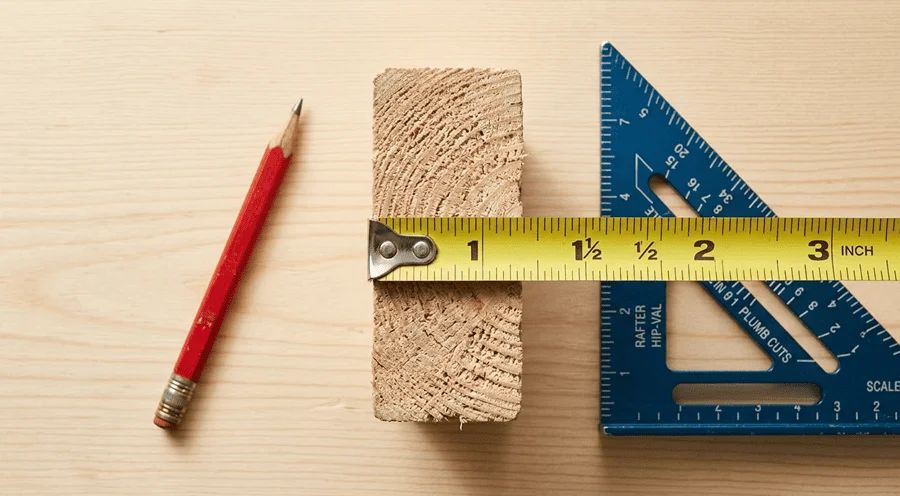
This one trips up beginners constantly, and honestly trips up some experienced builders too. When a plan says "2x4," that doesn't mean the lumber is literally 2 inches by 4 inches. Actual milled dimensions are 1.5" × 3.5". A plan written with nominal dimensions will produce parts that don't fit together properly once you cut them from real-world lumber. Every plan you use should specify actual cut dimensions, not store labels.
Numbered steps with a clear assembly order
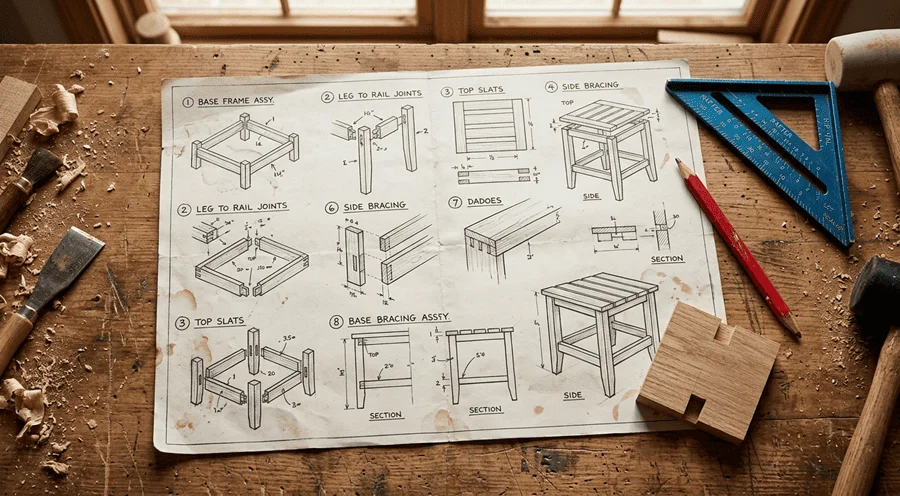
It sounds obvious, but most plans skip this. They show you what the finished piece looks like and list the parts — but don't tell you which piece attaches first, which joints need to dry before you add weight, or why you need to do things in a particular sequence. Good assembly order prevents the classic mistake of building yourself into a corner where you physically can't reach a joint anymore.
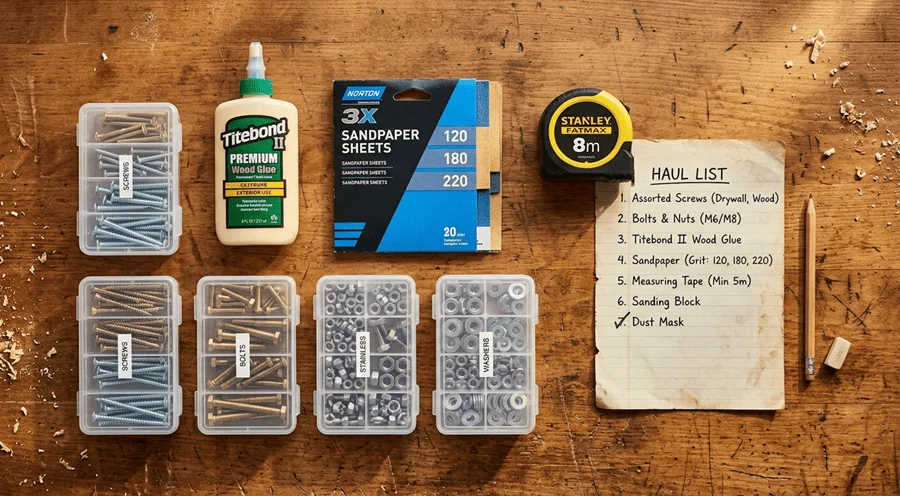
A complete, specific materials and hardware list
Not "several screws" or "appropriate clamps." A real plan tells you exactly how many screws, what size, what finish, what diameter dowels, what grade of sandpaper for each stage. Vague materials lists cost you time and extra lumber yard trips. Specific ones mean you walk in once with a list and walk out with everything you need.
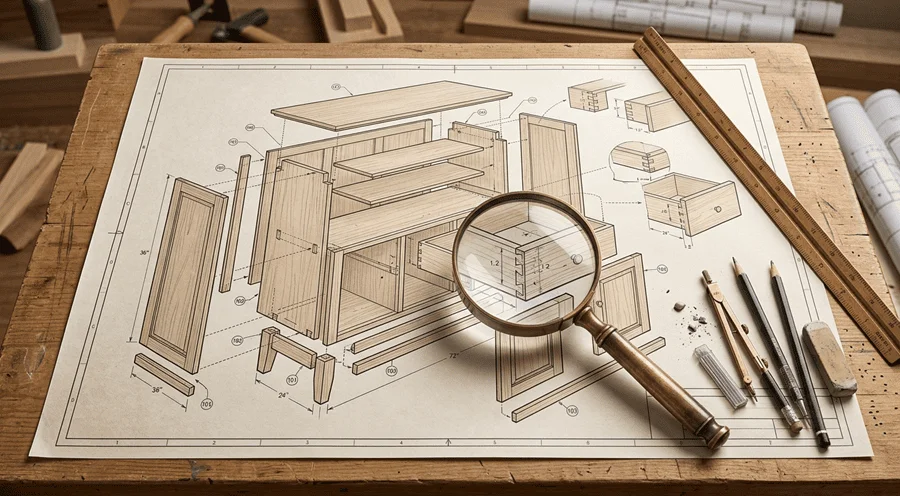
Multi-angle schematics with exploded joint views
A front elevation drawing shows you the finished front of the piece. That's useful. But you also need to see how the back panel attaches, how the drawer slides fit, how the mortise lines up with the tenon. Exploded views — diagrams that pull the assembly apart so you can see how each piece connects to the next — are what turn a confusing drawing into something you can actually build from.
Evidence the plan was physically built before publishing
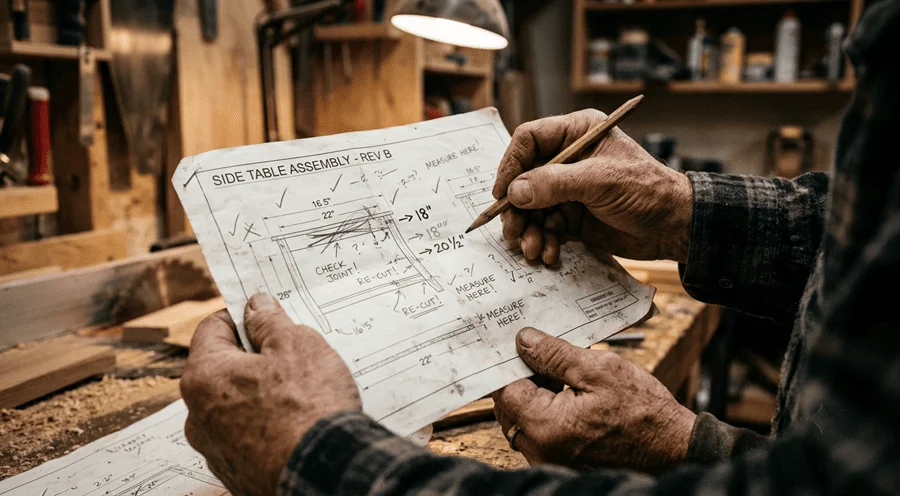
This is the big one. Any plan can look right on paper. A plan that's actually been built, where someone followed every step, cut every piece, and caught every error before it reached you — that's a different thing entirely. Ask yourself: does this plan feel like something drawn from memory, or something written down while building? The difference shows up around step six, every time.
Red Flags That Tell You a Plan Was Never Tested
After reviewing dozens of plan sources, these patterns keep appearing in plans that don't hold up at the bench:
- Steps that skip the hard part. "Cut the side panels. Now attach the face frame." What happened between those two steps? A plan that's never been built skips what's obvious to the designer but completely unclear to you.
- Materials listed as nominal sizes. Dead giveaway. Whoever wrote it worked on paper, not in a shop.
- No hardware specifications. Just "screws" or "fasteners" — no size, no count, no head type. You'll be guessing at the hardware store.
- No squaring or alignment instructions. How do you know if the cabinet is square before the glue dries? Good plans tell you. Bad ones assume you'll figure it out.
- Diagrams that only show the finished piece. Pretty photos. No process. A finished photo is inspiration, not instruction.
- Overly ambitious tool lists. A plan requiring a mortising machine, hollow chisel set, and router table for what's described as a "simple beginner shelf" is a plan that was designed to impress, not to be built by real people.
What to Do When You Find a Plan That Has These Problems
Honestly? The best thing to do is replace the plan, not improvise around it. Improvising on top of a broken plan compounds the errors — each adjustment you make to work around a bad measurement creates its own downstream problem.
If you're working from a plan and it starts going sideways, stop before you cut more material. Figure out where the plan diverges from reality. Then either find a corrected version of the plan or use your actual measurements going forward (marking directly from the previous piece rather than from the diagram).
The longer-term solution is to build a library of plans from sources that test them before publishing. It's not glamorous advice, but it's the most effective way to stop wasting weekends and materials on plans that were never going to work.
A Quick Checklist Before You Start Any New Plan
Before you buy your lumber or clear your Saturday, run through this:
- Does the plan use actual milled dimensions (not nominal)?
- Are steps numbered with a clear order, including assembly sequence?
- Is there a complete materials list with exact quantities and hardware specs?
- Are there multi-angle views showing how joints connect?
- Is there any indication this plan was physically built and tested?
- Do the tool requirements match tools you actually own?
- Does the difficulty level match your current skill honestly?
If you can check all seven, you're in good shape. If not, consider whether the gaps are things you can fill in yourself — or whether they're the kind of gaps that will cost you mid-build.
Where to Find Tested Woodworking Plans
There are a few reliable sources for plans that hold up in practice. For the most complete collection I've found — over 16,000 plans, each physically built and tested in a workshop before publication — TedsWoodworking is the one I keep coming back to.
What sets it apart from most plan sources isn't just volume. It's that every plan was built by a real person in a real shop, with errors caught at the workbench instead of passed along to you. The cut lists use actual dimensions. The assembly steps are numbered in order. The materials lists are specific down to the screw count.
For $67 as a one-time payment — covering 16,000 plans, lifetime monthly releases, and a custom plan request service — it's the best-value plan library I've found for USA woodworkers at any skill level.
Ready to Build From Plans That Actually Work?
16,000 tested plans, exact cut lists, step-by-step instructions — one-time $67, lifetime access. 60-day guarantee.
Get TedsWoodworking →