Chapter Two
3 Things That Kill the Woodworking Dream — Before You Ever Finish a Project
It usually starts well. You feel that pull — that specific, unmistakable itch to make something. Not someday. Now. This weekend. You clear a corner of the garage. You watch a few YouTube videos. You actually feel excited.
And then, quietly, it falls apart. Not all at once. In pieces. In private.
1. The Half-Finished Project You Don't Talk About
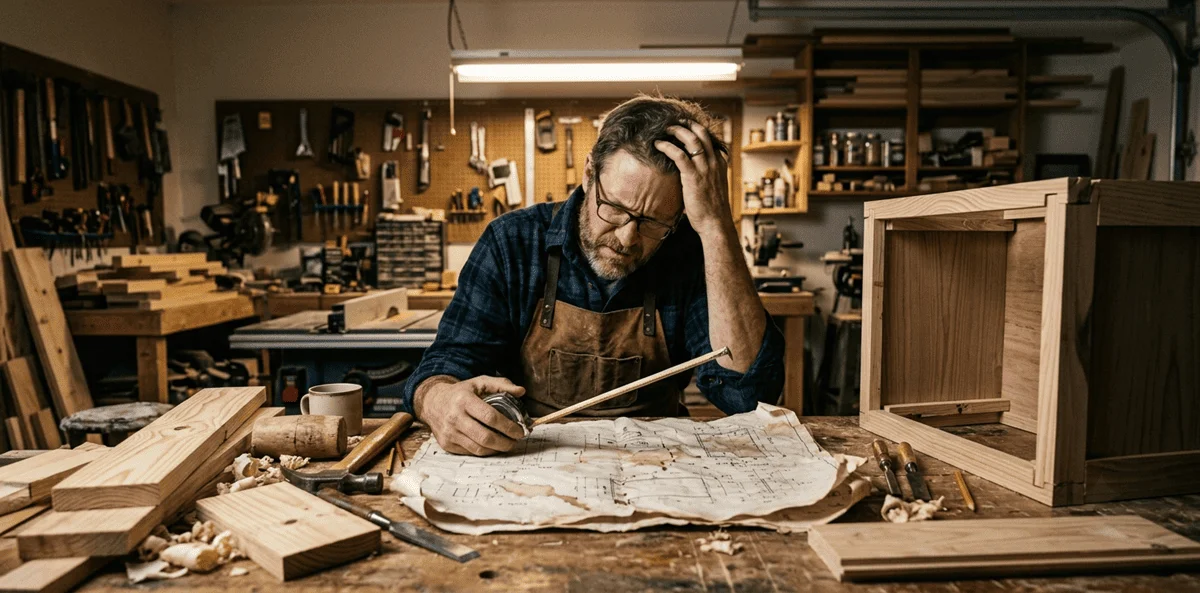
It's sitting there right now, isn't it? In the corner of the garage. Maybe under a tarp. A stack of boards you bought with good intentions, partially cut, still waiting. You tell yourself you'll get back to it. But every time you look at it, something deflates a little.
That project isn't a failure of discipline. It's a failure of the plan. You hit a step that didn't make sense, a measurement that didn't add up, a gap between "cut the panel" and "attach the frame" that nobody bothered to explain. So you stopped. Not because you're lazy. Because you were following instructions that were never actually tested.
2. The 11 PM YouTube Rabbit Hole That Never Leads Anywhere
You know the one. The house is quiet. Everyone's asleep. You open YouTube "just to look at one thing" — and an hour later you've watched six woodworking channels, saved eight tutorials you'll probably never watch again, and you're no closer to actually building anything.
The information is everywhere and it's useless because it's scattered. You need a project to finish, not more inspiration to add to a mental pile that's already too big to act on.
3. The Quiet Voice That Says "Maybe I'm Just Not Good At This"
This is the one nobody talks about. The lopsided shelf. The joint that doesn't quite close flush. The corner you had to fill with wood putty because the pieces didn't line up the way the diagram showed. You look at it and feel a small, private embarrassment — nothing you'd say out loud, but something you carry.
And slowly, "this plan didn't work" becomes "I can't do this."
"The problem was never your skill. It was never your tools. It was never your workshop. It was a plan that was drawn on a computer and published without a single cut being made. You were handed someone's theory and asked to build with it. Of course it didn't work."
This is the single biggest reason people quit woodworking who have no business quitting. Not lack of ability. Not lack of time. A plan that silently fell apart at step five — and a person who blamed themselves instead of the plan.
I know because I did exactly that. Twice. Before I found something completely different.

Ted "Woody" McGrath
Certified Master Woodworker · Educator · Trainer · Author · Member of AWI
Twenty-five years teaching 4,000+ students in hands-on workshop classes taught Ted one clear lesson: the #1 reason woodworkers quit has nothing to do with talent. It's plans that fall apart at step five. Every plan in his library gets physically built before it reaches you — mistakes caught in his shop, not yours.
Chapter Three
What Happens When Someone Actually Builds the Plan First
In 1989, Ted McGrath was teaching a Saturday workshop to eight people — all different skill levels, all building from a plan pulled from a well-known woodworking magazine. Professional layout. Decent diagrams. The kind of plan you'd trust.
By step six, three people were stuck.
The dado measurements in the plan assumed nominal lumber dimensions — the number printed on the label at the store — instead of the actual milled size of the wood once it's been surfaced and dried. A "1×6" board is not 1 inch by 6 inches. It's ¾" by 5½". Someone drawing plans on paper, who'd never actually cut the boards, had used the wrong numbers. One student had already cut his side panels from the diagram. They were wrong. Not because he couldn't measure. Because the plan was wrong.
That night, Ted took the plan home, threw it out, and rebuilt it from scratch. He built the cabinet himself — measuring every joint as he went, writing down every cut as he made it, finding better ways to do the awkward steps and writing those down too. He handed the rewritten plan to his next class. Nobody got stuck.
That was the moment he understood something most plan publishers never do: the only way to write a plan that works is to build the project first, then write the instructions from what you learned.
Twenty-five years later, Ted has a twelve-person team. All they do, full time, is design plans, build them in their workshop, catch the errors, fix the instructions, verify every measurement, and publish only when the plan produces a finished piece that matches the drawing. Five new plans every week. Fifty weeks a year. Two decades.
"If a step is confusing, we rewrite it. If a measurement is off by a sixteenth of an inch, we catch it in our workshop — not yours. You're not buying theory. You're buying blueprints that have already produced a finished piece."
That is the difference. Not in how the plans look on screen — anyone can make a plan look professional. The difference is what happens when a real person tries to follow it in a real shop with real lumber. And with TedsWoodworking, that test happens before the plan ever reaches you.

📐
Step-by-Step Instructions
Every step numbered, in order. Assembly sequence included. No gaps, no "figure it out" moments. Step 1 leads to Step 2 the way the build actually works — not the way it looks on paper.
📏
Actual Milled Dimensions
Not nominal sizes from a label. The dimensions your lumber actually measures after milling. This alone prevents the most common and costly beginner mistake.
🖼️
Multi-Angle Schematics
Exploded views that show every joint from multiple angles. You see how pieces connect before you cut them — not after you've already made an expensive mistake.
🔍
Searchable by Project or Skill
Over 100 categories, keyword search, difficulty filter. Find exactly the right plan in minutes — not hours of scrolling through a disorganized file dump.
🔧
Designed for Real Shops
Most plans need a table saw, drill, clamps, and a sander. That's it. Ted started in a 7×8 space. These plans were built for garages, not professional studios.
📅
New Plans Every Month, Free
Five new plans every week from live workshop classes, automatically added to your library. No subscription. No action needed. They just show up.