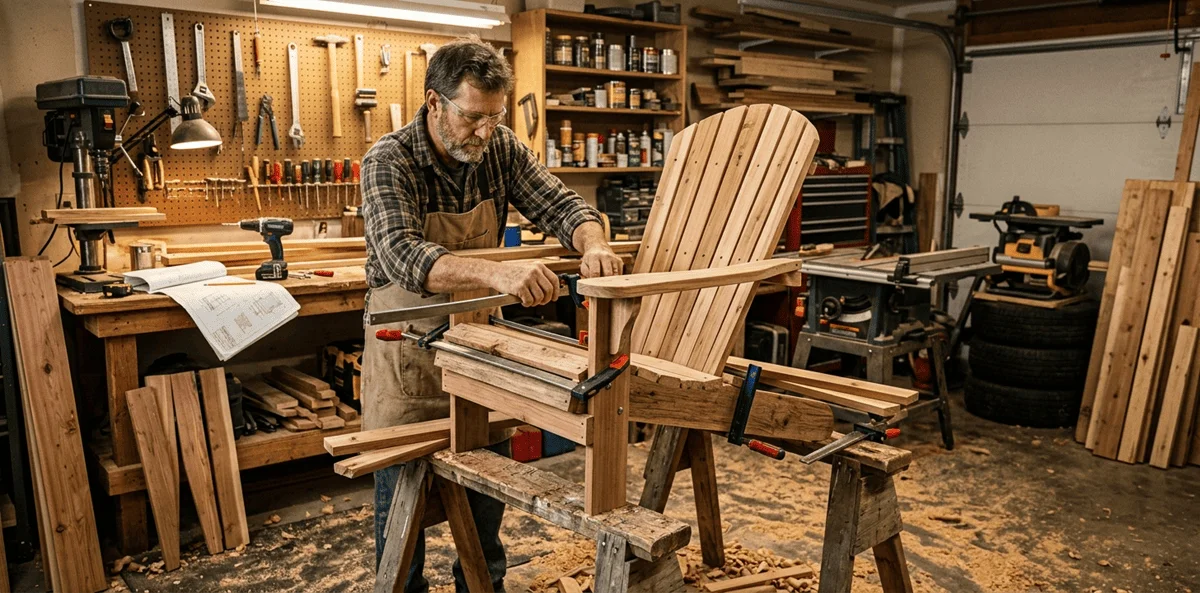
An Adirondack chair is one of the most satisfying projects a beginner woodworker can build. It looks impressive, it's genuinely useful, and once you've made one, people will ask you to make them more — often for money.
The design has been around since 1903. That longevity is no accident. The wide armrests, reclined back, and low seat are engineered for outdoor comfort. And from a woodworking standpoint, it teaches you angled joinery, curved cuts, and proper outdoor finishing — three skills that show up in dozens of future projects.
This guide walks through everything: the lumber you need, the cut list, the assembly sequence, and the finishing steps. At the end I'll point you to where I get my plans — because following a tested, complete plan makes the difference between a chair that wobbles and one your grandkids will still be sitting in.
📋 What's covered in this guide
Tools You Need
The good news: you don't need a fully equipped shop. Adirondack chairs were originally designed to be built with hand tools. With power tools it goes faster, but the list stays short:
- Table saw or circular saw — for ripping and crosscutting straight boards
- Jigsaw — essential for the curved cuts on the back slats and front apron. Nothing else cuts curves this cleanly at this scale.
- Drill/driver — for pilot holes and driving screws. Pre-drilling is non-negotiable with cedar; it splits easily near ends.
- Clamps — at least four. You'll need them while glue dries and while you align pieces before screwing.
- Speed square — for marking the angled cuts on the back legs accurately
- Tape measure and pencil
- Orbital sander — optional but saves significant time on the finish
Lumber and Materials List
Cedar is the standard choice for Adirondack chairs. It resists rot naturally, is lightweight, accepts paint and stain well, and has a pleasant smell when you cut it. It's slightly more expensive than pine but worth it for an outdoor piece.
If budget is tight, pressure-treated pine works fine and is more widely available. Avoid regular untreated pine for outdoor furniture — it won't survive more than one or two wet seasons.
| Material | Size | Qty | Est. Cost |
|---|---|---|---|
| Cedar board (back slats + seat slats) | 1×6 × 12 ft | 5 | ~$35 |
| Cedar board (arms + front apron) | 1×4 × 8 ft | 3 | ~$15 |
| Cedar (legs + supports) | 2×4 × 8 ft | 2 | ~$10 |
| Exterior deck screws (1-5/8") | #8 | 1 box | ~$8 |
| Exterior wood glue | — | 1 bottle | ~$6 |
| Outdoor wood sealer or paint | — | 1 qt | ~$14 |
| Total estimated cost | — | — | ~$88 |
Tip: Buy your lumber a day early and let it acclimate in your garage overnight. Cedar from the yard is often slightly damp. Letting it dry 24 hours reduces the chance of slight warping after assembly.
Cut List
This is the list of every piece you'll cut, with exact dimensions. Work through this before you start assembling — having every piece pre-cut and labelled saves confusion mid-build.
| Part | Width | Length | Qty | Notes |
|---|---|---|---|---|
| Back legs | 3½" | 34" | 2 | Cut 22° angle at top end |
| Front legs | 3½" | 21" | 2 | Square cuts both ends |
| Back slats (centre) | 5½" | 36" | 1 | Curved top — see plan |
| Back slats (outer) | 3½" | 29"–34" | 4 | Vary in height, curved top |
| Seat slats | 3½" | 21" | 5 | Square cuts both ends |
| Arms | 5½" | 28" | 2 | Curved front — see plan |
| Front apron | 5½" | 21" | 1 | Curved bottom edge |
| Back seat support | 3½" | 21" | 1 | Square cuts |
| Back support brace | 3½" | 24" | 1 | Cut 22° angle — matches back legs |
⚠️ Important note on dimensions
The widths above are actual milled dimensions — what you'll measure on the board at the lumber yard. A "1×6" board is actually 5½" wide. A "2×4" is actually 3½" × 1½". Always measure your actual lumber before cutting and adjust if needed. This is the most common source of errors in any woodworking project.
Step-by-Step Assembly
The assembly order matters. Build this out of sequence and you'll find yourself unable to reach a joint with your drill. Follow these steps in order.
Cut all pieces to size first
Work through the cut list completely before you assemble anything. Label each piece with masking tape as you cut it. The back slats look similar but vary in length — labelling prevents mixing them up at the worst moment.
Attach front legs to the front apron
Stand the two front legs parallel, 21" apart (outside to outside). Position the front apron between them at the top, flush with the top ends of the legs. Pre-drill two holes per side, apply a small amount of exterior glue to the joint faces, and drive your screws. Check that the assembly is square — measure diagonals, they should match.
Attach the back legs
Position each back leg so the angled top end faces rearward. The back leg sits behind the front leg assembly, with a 2" gap between front and back legs (this creates the angled seat). Screw the seat support board between the two back legs at the appropriate height — this supports the rear of your seat slats.
Add the seat slats
Lay the 5 seat slats across the seat frame, running front to back. Space them evenly with a ¼" gap between each — a 16d nail or a piece of ¼" hardboard works as a consistent spacer. Pre-drill every hole (two screws per end per slat = 20 screws total for the seat). Drive all screws flush or just slightly below the surface.
Assemble the back panel
Lay the back slats face-down on your bench, arranging them in order from tallest (centre) to shortest (outer edges). Clamp them together temporarily and check the fan shape looks right. Attach the two horizontal back support pieces across all slats — one near the top, one near the bottom. Pre-drill and screw from the back so screws are hidden from the front.
Attach the back panel to the chair
This step is easier with a helper. Tilt the completed back panel into position against the back legs. The back reclines at roughly 15–20°. Screw through the back legs into the back support pieces on each side. Check that the back is centred left-to-right before driving the final screws.
Attach the arms
Each arm rests on top of a front leg and the upper end of a back leg. The arm overhangs the front leg by about 2". Level the arm (it should be roughly horizontal despite the angled back leg) and screw down through the arm into both leg tops. The wide flat arm is what makes an Adirondack chair an Adirondack chair — make sure it's solid.
Sanding and Finishing
How your chair looks in five years depends almost entirely on how well you finish it now. Cedar is naturally rot-resistant but it will grey and crack outdoors without protection.
Sanding sequence
- Start with 80-grit to remove any rough spots, mill marks, or pencil lines
- Move to 120-grit for the main smoothing pass — this is what most of the sanding time is
- Finish with 150-grit on the seat slats and arm surfaces — anywhere skin will contact the chair
- Wipe all surfaces with a tack cloth or damp rag and let dry before finishing
Finish options
- Clear exterior sealer — lets the cedar colour show through. Reapply every 1–2 years.
- Exterior paint — the most durable option if you choose a quality outdoor paint. Classic colours: white, dark green, barn red, navy.
- Teak oil or Danish oil — deepens the natural wood tone. Requires annual reapplication but looks beautiful.
- No finish — cedar will naturally silver to a driftwood grey outdoors. Some people prefer this. The wood is still protected by its natural oils, just not as long-lasting.
Apply two full coats of whatever finish you choose, letting the first coat dry completely before the second. Pay extra attention to end grain — it absorbs more finish and is where moisture damage starts.
Where to Get Complete Adirondack Chair Plans
The cut list and steps above will get you a long way — but a complete set of plans with actual scaled drawings, multi-angle schematics, and the precise curve templates makes the difference between a straightforward build and one where you're guessing at critical dimensions.
The best source I've found for Adirondack chair plans specifically — and woodworking plans in general — is TedsWoodworking. The library includes over 80 Adirondack chair variations, from the classic design to wider loveseat versions, rocking versions, and folding designs. Every plan has been physically built in Ted's workshop before publication, which means the measurements are verified and the assembly steps are in the right order.
The full library of 16,000+ plans is available for a one-time fee of $67 — less than the lumber for one chair. It includes the DWG/CAD viewer that lets you print plans at any scale and adjust dimensions to fit your specific lumber.
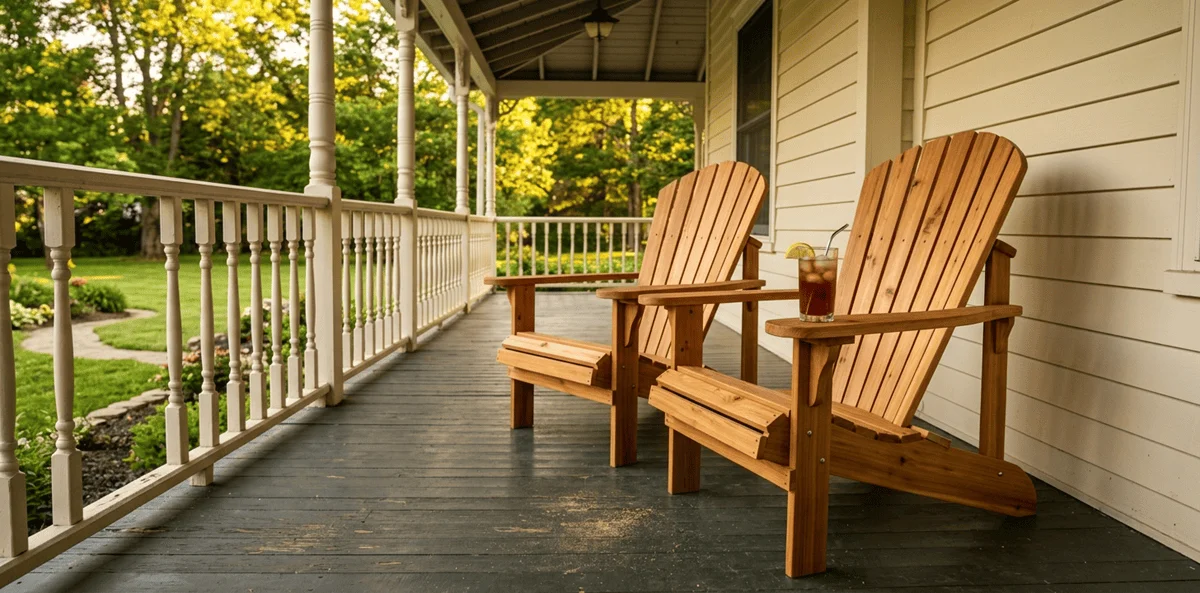
Get 80+ Adirondack Chair Plans + 16,000 More
Every plan tested in a real workshop. Exact cut lists, multi-angle schematics, complete materials lists. One-time $67, lifetime access, 60-day guarantee.
Get All Plans for $67 →Common Questions About Building Adirondack Chairs
More Woodworking Guides
If you found this useful, these guides cover related ground: